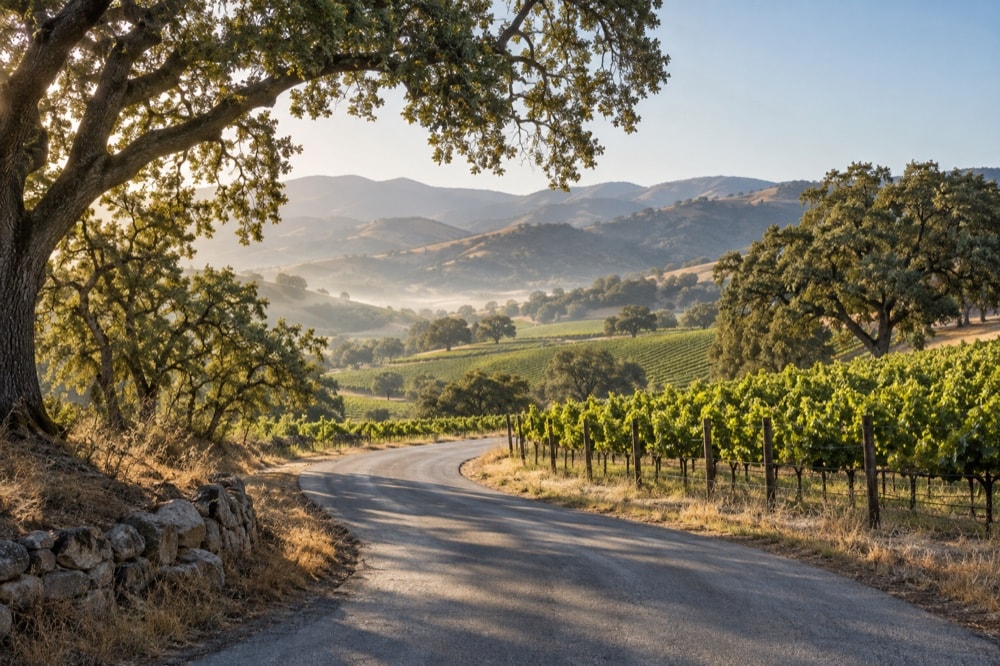
Wine makes more sense here when you begin with the valley rather than a tasting list. The Santa Ynez Valley runs broadly east to west, an unusual transverse orientation that allows cool Pacific air to travel inland. Western sites feel the marine influence most directly. Farther east, afternoons tend to become warmer and the growing conditions change. The landscape explains why a short drive can move between very different grape varieties and wine styles.
The larger appellation
The Santa Ynez Valley American Viticultural Area is part of California's Central Coast wine region. Within it, federal records identify four sub-appellations: Sta. Rita Hills, Ballard Canyon, Los Olivos District and Happy Canyon of Santa Barbara. The abbreviations and names matter; “Sta. Rita Hills” is the regulated form.
An appellation describes a legally defined place of origin. It is not a quality ranking and it does not make every vineyard within a boundary identical. Slope, soil, elevation, farming choices and the character of a growing season still influence what arrives in the glass.
Boundary source: The Alcohol and Tobacco Tax and Trade Bureau maintains the federal list of established wine appellations and identifies all four districts within the Santa Ynez Valley AVA. Consult the TTB appellation register.
West to east
Sta. Rita Hills occupies the cooler western reach, where wind, fog and maritime air help frame wines commonly associated with Pinot Noir and Chardonnay. Ballard Canyon sits farther inland and is closely associated with Syrah and other Rhône varieties. The Los Olivos District spreads across a gentler central alluvial landscape around the village and connecting roads. Happy Canyon of Santa Barbara lies toward the warmer eastern side, where Sauvignon Blanc and Bordeaux varieties have a stronger place in the regional story.
Those associations are a reading aid, not a tasting guarantee. A useful visit compares locations rather than chasing a long sequence of pours. Notice the temperature when you leave Buellton, the direction of the ridges, how exposed a slope feels and how the vegetation changes toward the east.
How to taste the geography
Choose one district or one compact town cluster for a day. Alternate tasting with water and food, and give conversation time to breathe. If you want to compare Pinot Noir, Chardonnay, Syrah and Sauvignon Blanc, spread the comparison across more than one day rather than racing between distant stops.
Most important, decide transportation before tasting begins. A sober driver, an arranged ride or a walkable cluster turns the day into an experience instead of a logistics problem. The wine touring guide explains route planning, seasons and pacing without directing readers to specific businesses.