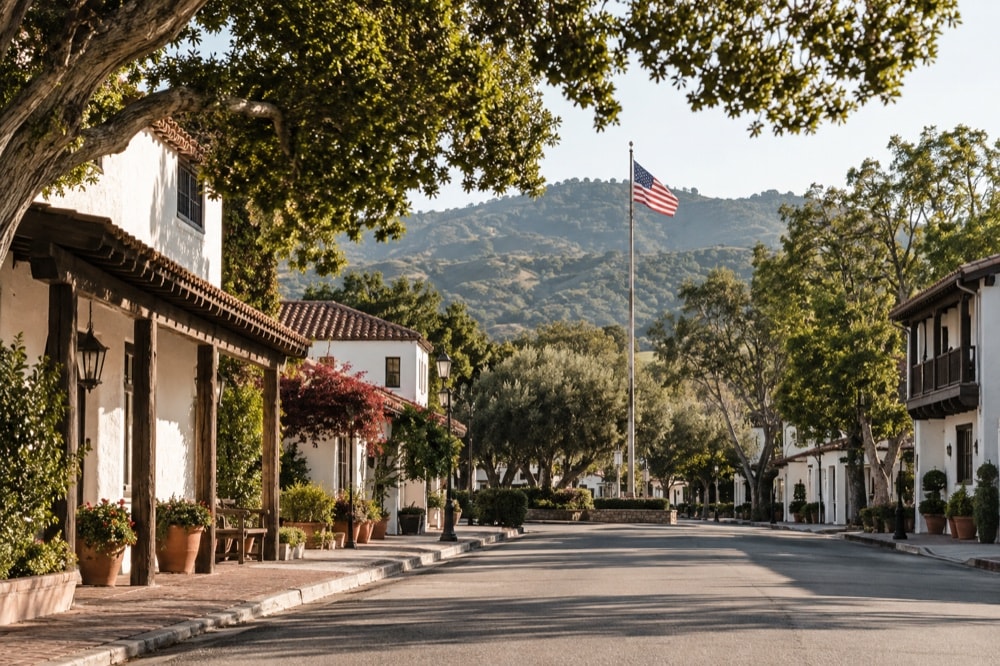
The Santa Ynez Valley is often described as one destination, but it makes more sense on the ground as six close communities. Each has a different relationship to the roads and surrounding land. Some announce themselves with a compact commercial center; others are little more than a schoolhouse, a crossing and a change in the spacing of the oaks.
Ballard
Ballard is rural in scale and easy to pass if the itinerary is moving too quickly. Its little red schoolhouse remains the visual landmark, but the larger impression comes from the roads around it: hedges, ranch entrances, open fields and mature valley oaks. Ballard suits a slow morning drive or a bicycle loop more than a packed sequence of stops.
Use it as a reminder that the valley is not only a series of town centers. The agricultural spaces between those centers are part of the experience, and they require courtesy: stay on public roads, respect private property and make room for working vehicles.
Buellton
Buellton is the practical gateway at US-101 and Route 246. It has the most direct relationship to highway travel and makes a useful point of arrival when coming from the north or south. Its broad road geometry feels different from the smaller inland villages, yet it places travelers within easy reach of the western wine country, the Santa Ynez River corridor and the road toward Solvang.
For trip planning, think of Buellton as a hinge. One direction leads west toward the cooler Sta. Rita Hills landscape; another continues east through the heart of the valley; a turn north opens the road to Los Alamos.
Los Alamos
Los Alamos gathers around a seven-block main street with a Western railroad-town character. The old depot landscape and low storefronts give the center a strong linear shape: park once, walk slowly and look at the details. It is separate from the central cluster of valley towns, which helps it keep a distinct sense of arrival.
The community works well as the first or last chapter of a visit rather than a hurried detour. Its antique-minded, small-town atmosphere belongs to the same valley story as vineyards and ranches, but it tells that story in older commercial buildings and the memory of rail travel.
Los Olivos
Los Olivos is compact, walkable and organized around a central flagpole. Galleries, small shops and tasting rooms have long clustered close together here, so the village rewards leaving the car behind. The surrounding roads return almost immediately to vines, horse country and open hills.
Because the center is small, it can feel busiest at midday. An early walk reveals the street pattern; a later loop into the countryside restores the wider scale of the valley. Keep tastings selective and plan the onward drive before stopping.
Santa Ynez
Santa Ynez carries the visual vocabulary of ranch country: low buildings, broad sky and references to the valley's equestrian past. It is also where the living Santa Ynez Band of Chumash Indians has its reservation and tribal government. That present-tense community belongs in any honest understanding of the place.
The town is well positioned for east-west travel on Route 246 and for roads that run north toward Ballard and Los Olivos. Its scale invites a short walk, while its setting makes it a natural bridge between village history and the open land beyond.
Solvang
Solvang is the valley's most recognizable townscape. Danish-inspired rooflines, courtyards, bakeries and pedestrian streets create a deliberately different experience from neighboring ranch towns. Danish-American heritage is visible in the architecture and in foods such as æbleskiver, while museums and Mission Santa Inés widen the historical frame.
The center is easy to explore on foot, but it deserves more than a quick photo stop. Look beyond decorative façades to courtyards, public spaces and the way the town meets the surrounding valley. Solvang can anchor an entire day, or it can serve as a measured eastern bookend to a drive through all six communities.
For the connections between these places, continue to orientation and getting here or use the getting-around guide to build a realistic loop.